Korngold was a formative composer for me. When I was first discovering classical music, two works by Korngold were an obsession: his symphony and violin concerto. I remember I often used to listen to them on bus trips in and out of Norwich during my final year at university. The violin concerto was always the Anne Sophie Mutter recording. Relistening to it again today, the theme, with its yearning augmented fourth suspension, still thrills me as if I were hearing it for the first time. The same is true of the percussive staccato chords that open the symphony, then the clarinet melody… God, it really is so wonderful.
Yet for some reason, until now, I had not listened to Korngold for years. Then a few days ago I read about this production of The Dead City, and thanks to the ENO’s generous Under 35s scheme — which I have used several times before and cannot recommend enough, especially in this mad year of vicious, stupid arts cuts, when the ENO needs all the support it can get — I was able to get a very good yet affordable ticket.
It was an enrapturing performance and production. Still, I would say it is one of those works that misses greatness ‘by a hair’ (to borrow from Mencken’s verdict on Mendelssohn). The music was always extraordinarily good, especially with its indulgent, brilliant harmonies. But the libretto creaks along with some pacing issues, and at nearly three hours the opera may be overlong. The sheer length and scale of the opera also creates a contradiction: everything happens in the one room, yet the music is even bigger, more luscious, and more soaring than Puccini. I left undecided whether this wholly worked (partly for reasons I’ll explain in a moment) — though it had an undeniable and irresistible power.
There is another obvious comparison with Puccini. Madama Butterfly is also, essentially, a single-room opera on a grand scale. But there is more going on in the background of Butterfly: ships arriving at port, rural life, a number of interesting visitors, and years pass in the narrative. The Dead City is mostly one man, Paul, who is not merely trapped in this one room but moreover (as we discover) trapped in the nightmare imaginings of his own grief.
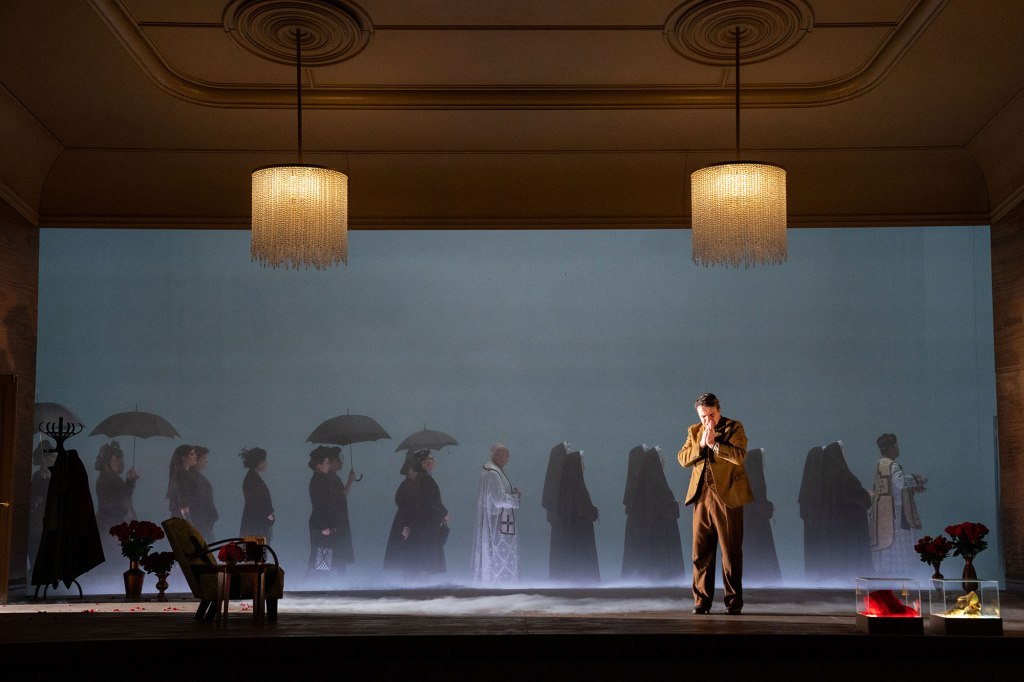
This is where the opera comes apart. Up until the end it was a mystery (at least to those of us who who had not read a synopsis) whether the ghostly visitations, the insane medical staff who revel in his room, the procession of mourners, the church choir, the affair with the temptress Marietta — it was a mystery as to whether these were supernatural, or hallucinatory, or the mangled interpretations of real events in the damaged mind of Paul, or just a dream state. It turns out to be the latter, which, if we must have an explanation, is the most boring one possible (‘it was only a dream’ is a terrible plot device). The dream was apparently a sort of psychology exercise: Paul was working out the morality of how to grieve and move on from the death of his wife.
Up until then, a few pacing problems aside, I was beginning to think this might be one of the best operas I’ve seen. Somehow Paul’s grief was more deeply felt before we discovered that these events had just been dreams. And the contradiction I mentioned earlier felt much less like a contradiction as the opera opened up and explored the fantastical; the dream plot-twist squashed the momentum of the story and felt like a sudden-onset of claustrophobia. I remember a ROH Don Giovanni production that had a comparable effect on me: instead of Don Giovanni being dragged into hell by the the statue of the Commendatore, he was left alone on stage, dragging himself into a mental hell of his own making. The modern liking for mechanistic or psychological explanations for everything is narrow and tedious.
But the rest of the The Dead City is superb, and the music is always ravishing. Besides, does an opera lose its greatness because of a less-than-good ending? Certainly some great novels and television dramas, say, have bad endings and yet remain great. Possibly the same is true of The Dead City. Listen here:
 Steven Watson
Leave a comment